Loreley
Whole-repository Quality-Diversity optimization for real git codebases.
Loreley is an automated Quality-Diversity optimization system that evolves entire git repositories, not just single files or scripts. It continuously samples promising commits, asks external agents to plan and implement changes, evaluates them, and archives the best-performing and most diverse variants for later reuse.
A git commit is the auditable source and ancestry representation. For compiled or generated targets, the evaluator can define a separate measurement identity, such as a release-binary hash, so source-distinct but equivalent artifacts do not require another benchmark.
Use this page as a high-level overview and a navigation hub into the focused module guides under loreley/ and script/ (see the sidebar navigation).
Evidence
The three-case-study evidence report summarizes the selection status, measurements, costs, and limits. The fixed repository studies are:
markdown-it-py: a preregistered winner was 6.75% faster on a separate 28-document corpus.python-pathspec: a four-generation archive lineage produced a qualifying 25.14% speedup. The candidate was selected post-hoc after the registered winner missed its allocation gate.- Zstandard V19: the registered winner improved sealed-holdout compression by 1.019% with neutral decompression. A Top-10 follow-up found a generation-4 candidate with a 0.891% fresh-corpus compression gain.
Read the project essay in Chinese or English. Teams with an automated evaluator can use the design-partner brief to assess fit and submit a non-confidential intake.
Challenges and core ideas
Loreley is built around three core ideas, each designed to address a concrete challenge in real-world code evolution:
| Challenge in real repositories | Loreley core idea |
|---|---|
| Single-file evolution cannot express cross-module refactors and production changes | Whole-repo evolution |
| Hand-crafted behaviour descriptors do not generalise across projects | Learned behaviour space |
| Long-running searches require persistent state, concurrency controls, and audit records | Persistent distributed loop |
Related systems include AlphaEvolve, OpenEvolve, and ShinkaEvolve.
Methodology
Loreley treats software evolution as quality-diversity search over the commit graph of a real repository, guided by a learned behaviour space and driven by a production-grade distributed loop. Instead of using LLMs as one-shot patch generators, it organises planning, editing, evaluation, and archiving into a repeatable system that can safely explore improvements while remaining auditable (git), testable (evaluator), and operable (scheduler + workers).
System overview
At a high level, Loreley sits between your git repository, a pool of LLM-based agents, and a MAP-Elites archive:
flowchart LR
  repo["Git repository<br/>(target project)"]
  sched["Scheduler<br/>(EvolutionScheduler)"]
  queue["Redis / Dramatiq<br/>(job queue)"]
  w1["Evolution worker 1"]
  wN["Evolution worker N"]
  db[("PostgreSQL<br/>(experiments + metrics)")]
  archive["MAP-Elites archive<br/>(learned behaviour space)"]

  repo --> sched
  sched -->|enqueue evolution jobs| queue
  queue --> w1
  queue --> wN

  w1 -->|checkout + push commits| repo
  wN -->|checkout + push commits| repo

  w1 --> db
  wN --> db

  db --> archive
archive -->|sample base commits| sched- Scheduler keeps the experiment in sync with the repository, ingests completed jobs, samples new base commits from the MAP-Elites archive, and enqueues evolution jobs.
- Workers check out base commits, call external planning/coding/evaluation agents, create new commits, and persist metrics.
- Archive stores a diverse set of high-performing commits in a learned behaviour space that the scheduler uses to inspire the next round of jobs.
Quick start
Requirements
- Python 3.11+
uvfor dependency management- PostgreSQL and Redis
- Git (including worktrees; LFS optional)
Install dependencies
git clone <YOUR_FORK_OR_ORIGIN_URL> loreley
cd loreley
uv sync
Start PostgreSQL + Redis (recommended for local dev)
If you have Docker installed, you can start the required services with:
docker compose up -d postgres redis
PostgreSQL 18 stores data under /var/lib/postgresql/18/docker. The Compose
file mounts the named volume at /var/lib/postgresql and sets PGDATA to that
versioned directory. If you only have disposable local data from an older
layout, run docker compose down -v before restarting; this deletes the local
database volume.
Configure
All runtime configuration is provided via environment variables and loaded by loreley.config.Settings.
Copy the example env file:
cp env.example .env
APP_NAME,APP_ENV,LOG_LEVELDATABASE_URLTASKS_REDIS_URL,EXPERIMENT_ID(UUID or slug)OPENAI_API_KEYor (OPENAI_DYNAMIC_API_KEY_PROVIDER+OPENAI_DYNAMIC_API_KEY_TTL_SECONDS)MAPELITES_CODE_EMBEDDING_DIMENSIONSMAPELITES_EXPERIMENT_ROOT_COMMITMAPELITES_OBJECTIVES(ordered objective names andmax/mindirections)MAPELITES_ISLANDS(ordered island IDs; the first is the CLI/API default)SCHEDULER_MAX_TOTAL_JOBS,SCHEDULER_REPO_ROOT,WORKER_REPO_REMOTE_URLWORKER_EVALUATOR_PLUGIN- (recommended)
WORKER_EVOLUTION_GLOBAL_GOAL - (optional)
WORKER_PLANNING_BACKEND,WORKER_CODING_BACKEND - (optional)
WORKER_KILOCODE_BIN,WORKER_KILOCODE_AGENTwhen using the default Kilocode CLI backend (kilo)
See: Configuration
Run
Preflight checks:
uv run loreley doctor --role all
Note: on first start the scheduler performs a repo-state root scan at MAPELITES_EXPERIMENT_ROOT_COMMIT and requires operator approval. In non-interactive environments, pass --yes or set SCHEDULER_STARTUP_APPROVE=true.
uv run loreley scheduler
uv run loreley worker --processes 4
uv run loreley status
See: Running the scheduler, Running the worker
Core ideas in practice
Whole-repo evolution
Whole-repo evolution uses the git commit as the reproducible source and ancestry unit. Real improvements can require changing multiple modules, updating configs and build scripts, and keeping tests and tooling intact. The evaluator can additionally group commits by binary, artifact, trace, or another identity relevant to measurement.
Repository-scale evolution has been demonstrated in the literature. For example, SATLUTION uses a champion/challenger process and an explicit rulebase to evolve SAT solver repositories. Loreley explores a different design point: a bounded archive retains multiple candidates across behavioral niches and objective trade-offs.
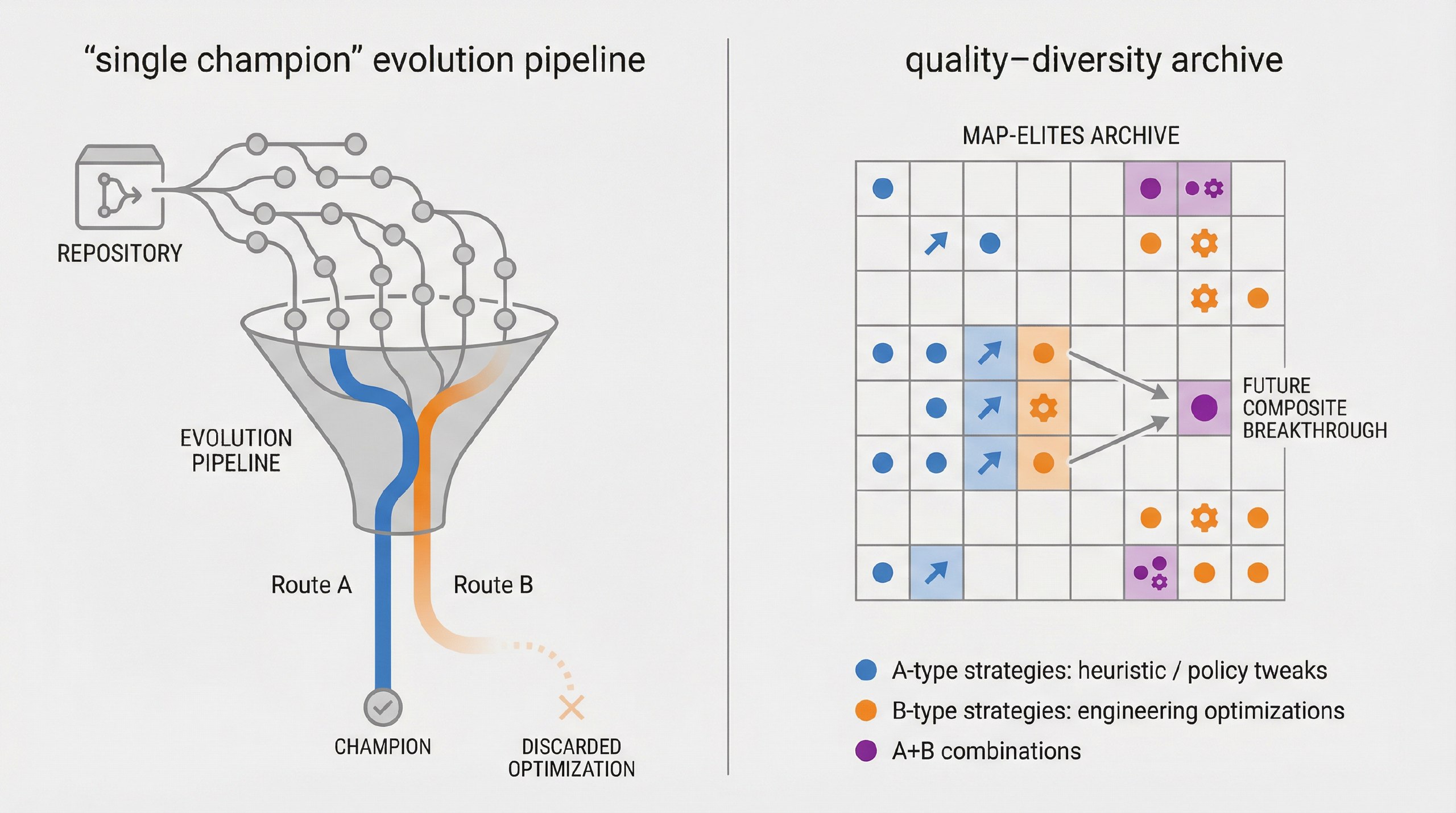
Loreley is designed to be QD-native at repository scale:
- it keeps a bounded Pareto front of multiple elites in every occupied behavioural niche,
- it schedules independent configured islands fairly and periodically injects a donor elite as a cross-island inspiration,
- it samples from those niches as inspirations for new jobs,
- and it places project-specific correctness, performance, and scope constraints in the evaluator contract.
Learned behaviour space
Quality-diversity methods require a behaviour space. Hand-crafted behaviour descriptors (file counts, line deltas, test counts, etc.) are brittle and often project-specific.
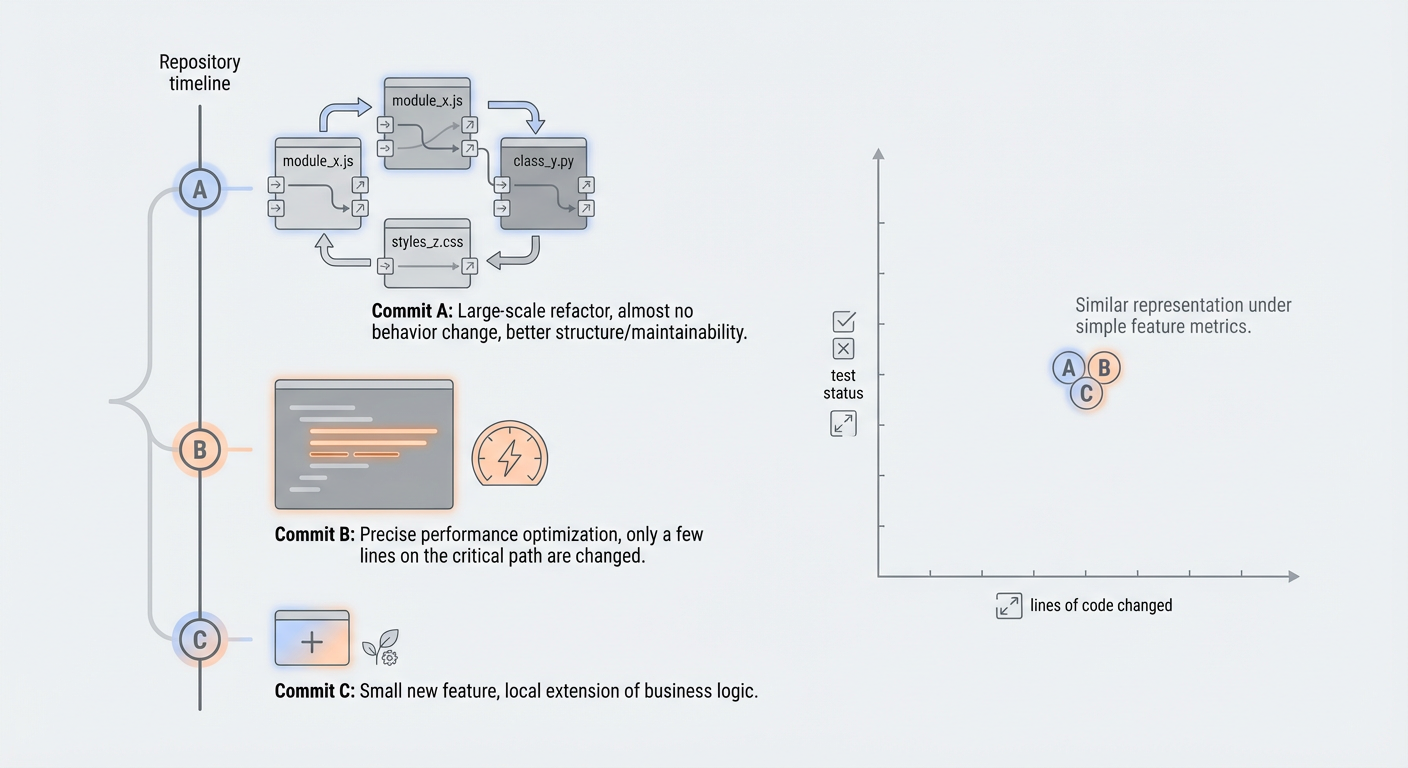
Loreley derives behaviour descriptors from repo-state code embeddings (file-level embeddings cached by git blob SHA and aggregated into a commit vector), optionally reduced with PCA.
Across similar primary-objective values or different Pareto trade-offs, the archive can preserve structurally different improvements (refactors vs micro-optimisations vs feature shifts) as distinct behavioural niches, enabling exploration without collapsing to a single style of change.
Persistent distributed loop
Long-running evolution requires more than an agent loop: it needs distributed execution, resource controls, and persistent traceability.
Loreley runs a long-lived loop with:
- a scheduler that ingests completed jobs, samples base commits, and enqueues new jobs,
- a Redis/Dramatiq worker fleet that runs planning/coding/evaluation per job,
- a PostgreSQL-backed store for experiments, commits, metrics, and archive state,
- explicit lifecycle controls (max unfinished jobs, required total job cap, seed population, primary-objective branch export).
You can run a long optimisation campaign on a repository, scaling workers horizontally, while keeping the evolution process reproducible and observable.
Adoption checklist (is your project a fit?)
A project is a strong fit for Loreley when these questions have clear, automated answers:
- Do you have an evaluator that can run unattended and produce structured metrics (plus pass/fail correctness gates)?
- Is the evaluation signal comparable across commits and not dominated by noise?
- Is the per-job evaluation cost acceptable (P50/P95 runtime), and can it be parallelised or staged (smoke test → full benchmark)?
- Do meaningful improvements often require cross-file and cross-module changes?
- Can failures be detected cheaply (compile/test/correctness gates) to avoid wasting full benchmark runs?
- Can the project tolerate continuous creation of job branches / commits (ideally on a dedicated remote or mirror)?
- Is there value in keeping multiple diverse strong solutions (trade-offs, strategies, module-level variants), not just a single best commit?
What you need to integrate a project
To hook a repository into Loreley, you typically need:
- Repository info: remote URL/branch, LFS/submodules, reproducible environment (toolchains, containers, hardware).
- Build & test entrypoints: minimal commands for build/test, plus optional staged checks (smoke vs full).
- Evaluator spec: plugin entrypoint, metrics schema, correctness validation, and any benchmark/data access details.
- Goal & constraints: the optimisation objective, non-negotiable constraints, acceptance criteria, and forbidden areas.
- Resources & ops: worker concurrency, CPU/GPU/memory budgets, and runtime/timeouts.
Estimating cost and ROI
A practical way to estimate cost/benefit is to run a small pilot (e.g. 20–50 jobs) and measure:
t_job(time per job):
t_job = t_plan + t_code + t_build + t_eval + t_ingest
jobs_per_day ≈ workers * 24 / E[t_job]
p_valid(valid-job rate): fraction of jobs that pass correctness gates and produce usable metrics.- primary-objective improvement distribution
Δ: value(new) − value(base) across valid jobs, interpreted using the configured direction.
From these, you can forecast:
- time-to-first-win: how many valid jobs you typically need to see a meaningful improvement,
- expected best-of-N: how the best improvement grows as you run more valid jobs,
- $ / improvement: combine LLM + compute costs per job with the observed success rate.
Documentation map
Use this index as a quick map of the rest of the documentation:
- Releases
- Unreleased
- v0.9.0-alpha
- v0.8.4-alpha
- v0.8.3-alpha
- v0.8.2-alpha
- v0.8.1-alpha
- v0.8.0-alpha
- Configuration
- Global settings
- Campaigns
- Campaign program
- Experiments
- Repository and experiment helpers
- Database
- Engine and sessions
- ORM models
- Core contracts
- Hot-path contracts
- Scheduler
- Scheduler overview
- Job scheduling
- Ingestion
- MAP-Elites core
- Overview & archive
- Repository embeddings
- Preprocessing
- Chunking
- Code embeddings
- Dimensionality reduction
- Sampler
- Snapshots
- Worker pipeline
- Worker repository
- Planning agent
- Agent backends and runner
- Coding agent
- Evaluator
- Evolution loop
- Commit cards
- Commit summaries
- Artifacts
- Job store
- Tasks
- Tasks broker
- Tasks workers
- UI (optional)
- UI API (
loreley.api) - Agent REST API
- Streamlit UI (
loreley.ui) - Operations
- Doctor checks
- Status
- Database schema commands
- Managing jobs
- Job lease recovery
- Archive stats
- Config dump
- Running the scheduler
- Running the worker
- Running the UI API
- Running the UI
- Resetting the database
- Benchmarking
- Architecture decisions
- ADR index
Next steps
- Start by configuring a small test repository and running the scheduler/worker pair locally.
- Once the basic loop works, plug in a custom evaluator and tune
MAPELITES_*settings. - When you are ready for production, point the scheduler at a long-lived repository clone and supervise both processes with your preferred process manager.